
A buyer's guide to choosing a payment API for Indonesia
What to check before you choose a payment API for Indonesian customers: payment methods, testing, webhooks, settlement, costs and support.
Published 04 October 2026 3 min read

Choosing a payment API is a decision you will live with for years: switching later means rewriting your checkout, your webhooks and your reports. This guide lists what to check before you choose, especially if your customers are in Indonesia.
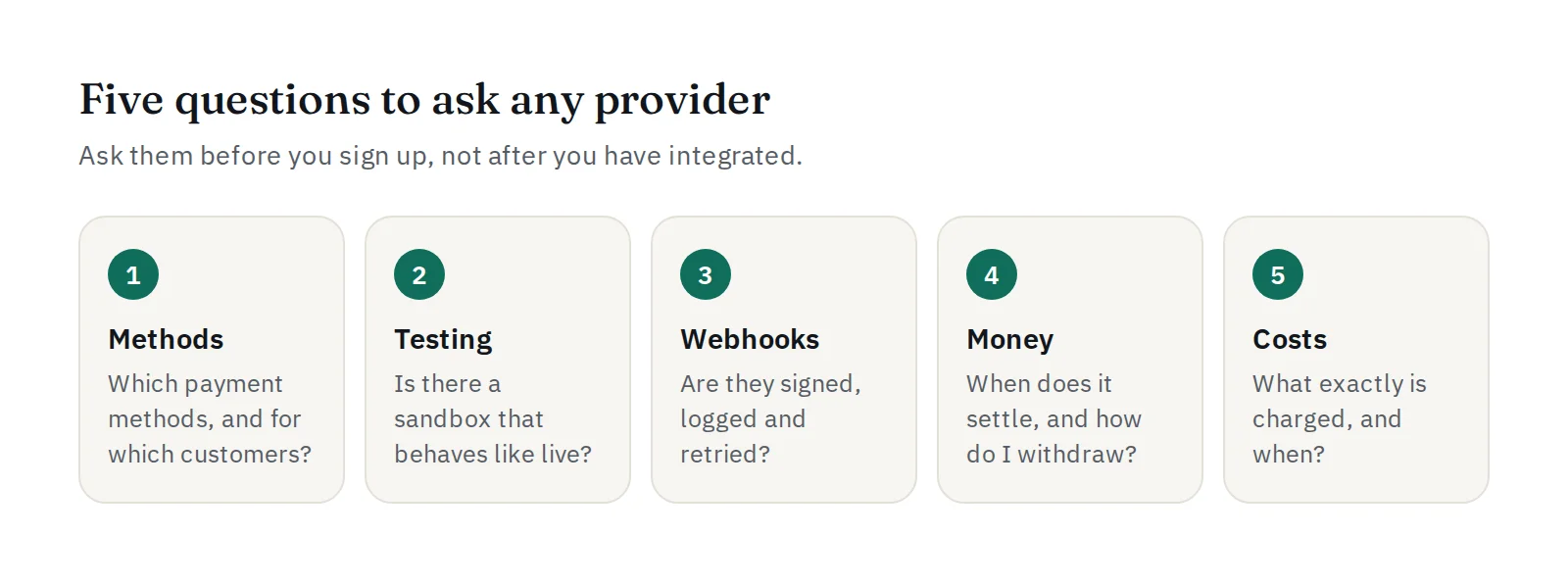
1. Payment methods your customers actually use
In Indonesia, QRIS is the method that reaches almost everyone: one QR code that can be paid from any bank or e-wallet app. If you also sell to customers abroad, or to people who prefer crypto, a stablecoin such as USDT can be useful. Check exactly which methods are live, which networks are supported (for USDT: which chain), and the minimum and maximum per payment.
2. A sandbox that behaves like live
A good provider lets you test the whole flow without real money: creating payments, paid, failed and expired outcomes, and the webhooks that follow. Ask whether sandbox and live use the same API, so the code you tested is the code you ship.
3. Webhooks you can trust
Your system learns about payments through webhooks. Ask:
- Are webhooks signed, so you can reject fake ones?
- Are failed deliveries retried automatically?
- Can you see every delivery attempt and resend one yourself?
4. Settlement and withdrawals
Getting paid matters as much as accepting payments. Ask when paid transactions become available, in which currency, and how withdrawals work: to which accounts, with which fees and limits, and whether you can follow each withdrawal until it is completed.
5. Costs you can predict
Look for a clear answer to "what exactly am I charged, and when?". Watch out for setup fees, monthly fees, fees on failed payments, and currency conversion margins. Ask whether the fee is shown on every transaction.
6. Day-to-day tools
Your finance and support teams will use the dashboard every day. Check for transaction search and filters, exports, statements, team roles, two-factor sign-in, and an API log your developers can use to debug.
7. Honesty about what the provider is
A payment provider should say clearly what it does and what it does not do. PAYWISE, for example, is not a bank and does not hold deposit accounts: it lets you accept QRIS and USDT payments and withdraw what you have been paid.
How PAYWISE answers these questions
- Methods: QRIS (IDR) and USDT on BNB Smart Chain (BEP20), through one API.
- Testing: a sandbox with
pw_test_keys and a "simulate the result" button. - Webhooks: HMAC-SHA256 signatures, automatic retries, a full delivery log.
- Money: QRIS settles in batches several times a day, USDT when paid; withdrawals to a bank account or BEP20 wallet, tracked to completion.
- Costs: a percentage of paid transactions only, no setup or monthly fees. See pricing.
Whatever you choose, ask every provider the same questions, and test before you commit.