

QRIS fees for small sellers: what MDR means, with real examples
What MDR is, how a payment gateway fee works, and worked examples for a small online shop: per order, per day, per month and per withdrawal.
Published 11 October 2026 3 min read

"How much does QRIS really cost me?" is one of the first questions small sellers ask. The answer is simple once you know the two words that come up: MDR and the payment gateway fee. This article explains both and works through examples for a small online shop.
What is MDR?
MDR (Merchant Discount Rate) is the percentage of a QRIS payment that is charged to the merchant. It is set by Bank Indonesia. Since 1 October 2026, MDR is 0% for every merchant on payments up to Rp100,000, and 0% for micro businesses up to Rp500,000. Above those amounts, the usual rates apply (for example 0.3% for micro businesses and 0.7% for small, medium and large businesses). The full table is in QRIS MDR fees from 1 October 2026.
Two rules matter for sellers: MDR is paid by the merchant, and it may not be added to the customer's bill as a surcharge.
What about the payment gateway?
If you sell online, you usually do not deal with MDR directly. A payment gateway creates a QR code for each order, confirms the payment for you, and charges its own service fee. Every gateway sets its own price, so always compare what you actually pay per order.
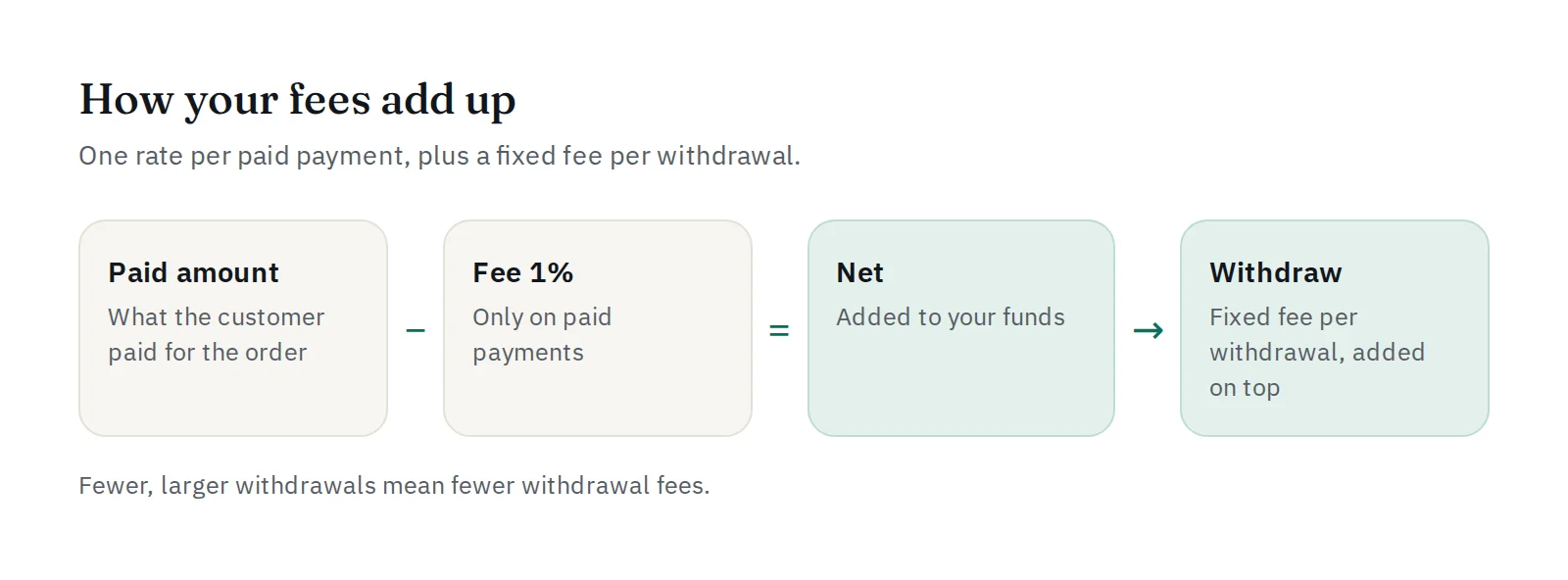
On PAYWISE, QRIS has one published rate: 1% of each paid payment. That is the only per-payment fee on your PAYWISE statement. Failed, expired and pending payments cost nothing, and there is no setup or monthly fee.
Example 1: one order
A customer pays Rp50,000 for an order.
| Amount | |
|---|---|
| Customer pays | Rp50,000 |
| Fee (1%) | −Rp500 |
| You receive | Rp49,500 |
Every transaction in your dashboard shows these three numbers: gross, fee and net.
Example 2: one day
A small shop has 40 paid orders today at an average of Rp35,000.
- Total paid: 40 × Rp35,000 = Rp1,400,000
- Fees: 1% = Rp14,000
- Net: Rp1,386,000
Five customers did not finish paying and their QR codes expired. Those five cost you nothing.
Example 3: withdrawals
When you move money to your bank account, each withdrawal has a fixed fee, shown on the withdrawal form before you confirm (the standard fee for QRIS is Rp5,000). It is added on top of the amount you enter, so the amount you choose is exactly what arrives.
Over a 30-day month:
- Withdrawing every day: 30 × Rp5,000 = Rp150,000
- Withdrawing twice a week: about 9 × Rp5,000 = Rp45,000
The sales are the same; only the number of withdrawals changes. Read cash flow tips for planning your withdrawals.
Example 4: a full month
With 40 orders a day for 30 days at Rp35,000:
| Amount | |
|---|---|
| Total paid | Rp42,000,000 |
| Payment fees (1%) | −Rp420,000 |
| Withdrawal fees (9 withdrawals) | −Rp45,000 |
| Total cost | Rp465,000 (about 1.1%) |
Tips to keep your costs low
- Withdraw less often, in larger amounts.
- Build the cost into your prices instead of adding a surcharge at checkout. Customers dislike surprise fees.
- Compare the full cost, not only the headline rate: setup fees, monthly fees and fees on failed payments add up.
- Large volume? Rates are negotiable. Message us on Telegram at @paywise_asia.
See the pricing page and how PAYWISE fees work for the details.