

The benefits of a unified payment API for fintech teams
One API for QRIS and USDT means less code, one webhook format, one place to look and a payment stack that stays reliable as you grow.
Published 04 October 2026 2 min read

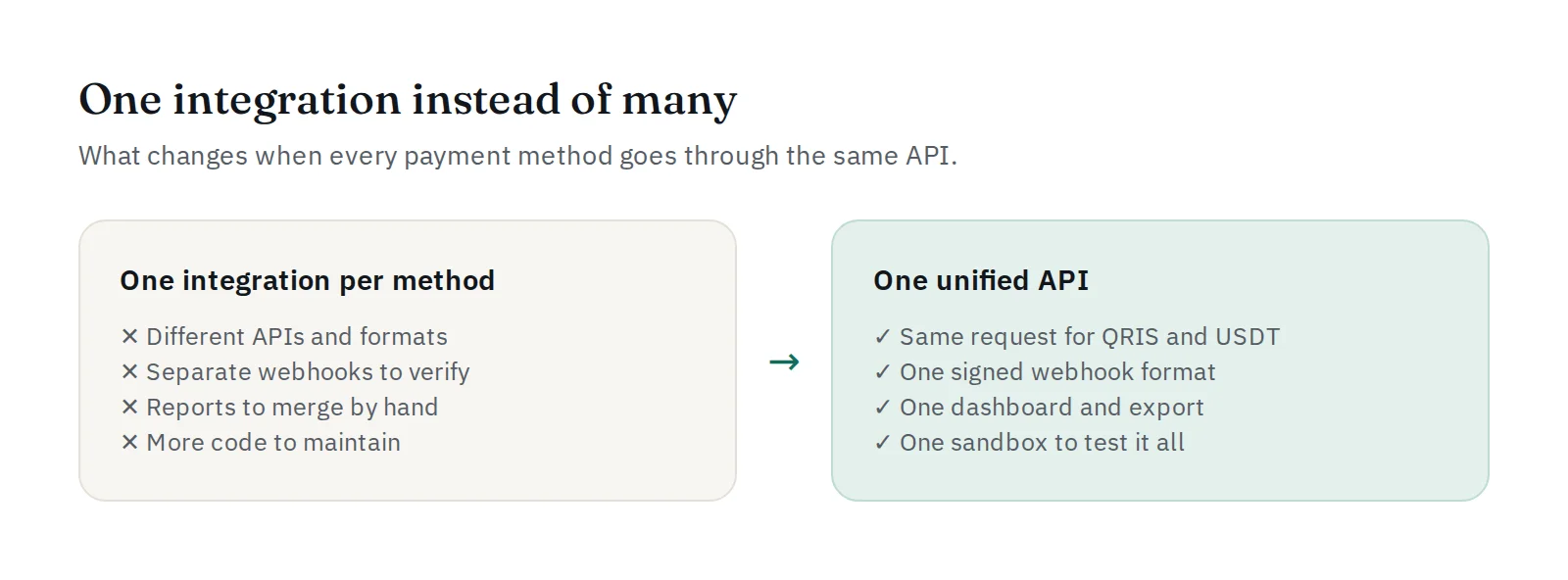
Many teams start with one payment method, then add a second, then a third, each with its own provider, its own API and its own dashboard. It works, until something goes wrong and nobody knows which system to look at. A unified payment API puts every method behind one integration. Here is what that changes in practice.
1. You write the integration once
With PAYWISE, a QRIS payment and a USDT payment are created with the same request to POST /api/v1/transactions. Only payment_method changes (and network for USDT). Adding a method later is a few lines, not a new project.
2. One webhook format to verify
Every status change arrives in the same JSON shape, signed the same way with HMAC-SHA256. Your server has one handler and one signature check, not one per provider. See Verifying webhook signatures.
3. One record per payment
Each transaction keeps your order ID (merchant_reference), your customer ID, its status, and its gross, fee and net amounts. Finance, support and developers all look at the same record instead of comparing exports from different systems.
4. Reliability built into the API
A scalable payment API has to be predictable under load and safe to retry. PAYWISE gives you:
- idempotent creation: sending the same
merchant_referenceagain returns the original payment instead of a duplicate, so a timeout is safe to retry; - clear error codes with the right HTTP status, for example
409 DUPLICATE_REFERENCEor429 RATE_LIMITED; - an
X-Request-Idon every response, and a log of every call in your dashboard; - automatic webhook retries, with every attempt and its result recorded;
- a public status page that shows how each part of the platform is doing.
5. One sandbox for everything
Sandbox keys (pw_test_) work for every method. You can test QRIS and USDT payments, including failed and expired ones, before any real money moves. See Test everything in the sandbox.
6. One place to get paid
Paid QRIS transactions are withdrawn in IDR to a bank account, paid USDT to a BEP20 wallet, from the same Finance Center, with every withdrawal tracked to completion.
7. Less to maintain
Fewer integrations mean fewer SDKs to update, fewer credentials to rotate and fewer places where something can break. Your team spends its time on your product, not on payment plumbing.
Ready to try it? Create an account and send your first sandbox payment in minutes.