

What is QRIS? How it works, costs and benefits for businesses
QRIS is Indonesia's national QR payment standard. Learn how it works, the difference between static and dynamic QRIS, what it costs and why businesses use it.
Published 04 October 2026 2 min read

If you shop in Indonesia, you have almost certainly paid by scanning a QRIS code. But what exactly is it, and what does it mean for a business that wants to accept it?
QRIS in one sentence
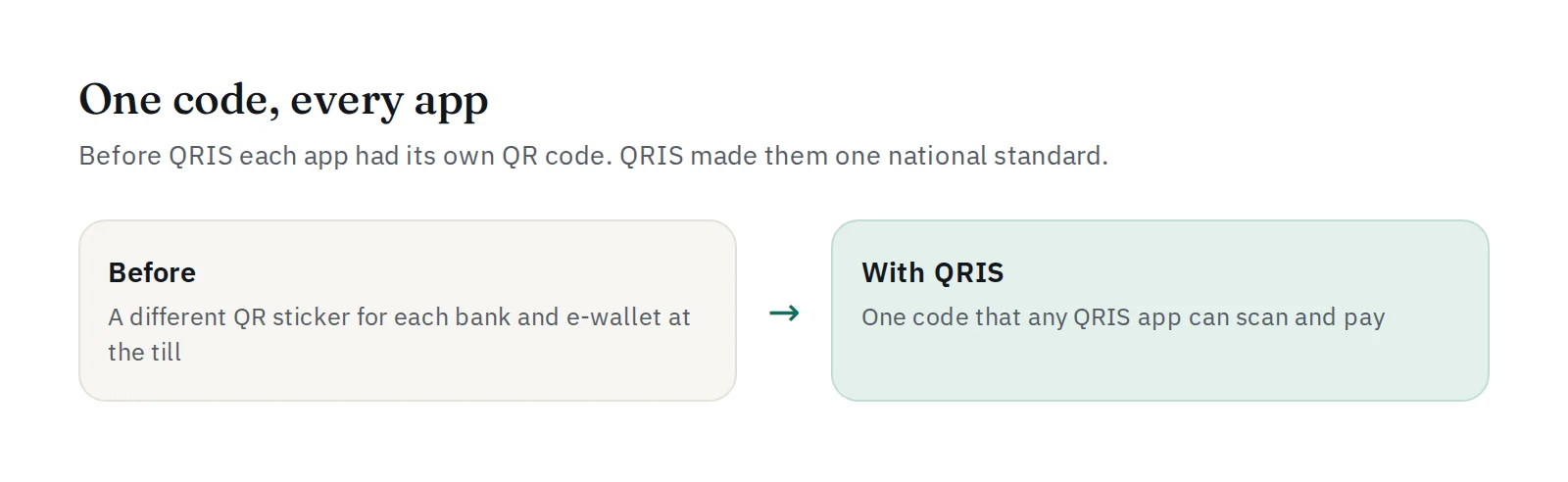
QRIS (Quick Response Code Indonesian Standard) is the national standard for QR code payments, set by Bank Indonesia. One QRIS code can be paid from any QRIS-enabled banking or e-wallet app. Bank Indonesia launched it on 17 August 2019, and it has been mandatory for QR payments since 1 January 2020.
How a QRIS payment works
- The merchant shows a QRIS code, printed or on a screen.
- The customer opens their banking or e-wallet app and scans it.
- The customer confirms the amount and pays.
- The money moves from the customer's account to the merchant's provider, and the payment is confirmed within seconds.
Static vs dynamic QRIS
- Static QRIS is one printed code for the whole shop. The customer types the amount, and the merchant has to check each payment.
- Dynamic QRIS is generated for each order, with the amount already inside. Nothing has to be typed, and the payment can be matched to the order automatically.
Online shops and apps use dynamic QRIS, which is what PAYWISE creates for every payment through its API.
What does QRIS cost?
Merchants pay a Merchant Discount Rate (MDR) set by Bank Indonesia; customers pay nothing extra. From 1 October 2026, payments up to Rp100,000 have 0% MDR for every merchant, and up to Rp500,000 for micro businesses. Read QRIS MDR fees from 1 October 2026 for the full table.
Why businesses use QRIS
- Every customer can pay, whatever bank or e-wallet they use.
- No card terminal is needed: a code on a screen or a sticker is enough.
- Fast confirmation, which matters at a busy till or a checkout page.
- Cross-border payments: QRIS is linked with QR systems in several countries, including Thailand, Malaysia and Singapore.
Accepting QRIS online
To accept QRIS on a website or in an app, you need a provider that can create a dynamic QR for each order and tell your system when it is paid. With PAYWISE that is one API call and one webhook. See How to accept QRIS payments.