

Crypto payments for business: rules, risks and how to do it safely
Before you accept USDT or other crypto: what the rules usually say, the main risks for a business, and the habits that keep crypto payments safe.
Published 11 October 2026 3 min read

More and more customers, especially from abroad, ask to pay with crypto. Stablecoins like USDT make it practical: the value stays close to one US dollar, and a payment arrives in minutes from anywhere in the world. But before you add crypto to your checkout, you should know three things: the rules, the risks and the safe habits.
This article is general information, not legal or tax advice. Rules change and differ per country: check them with a qualified adviser for your situation.
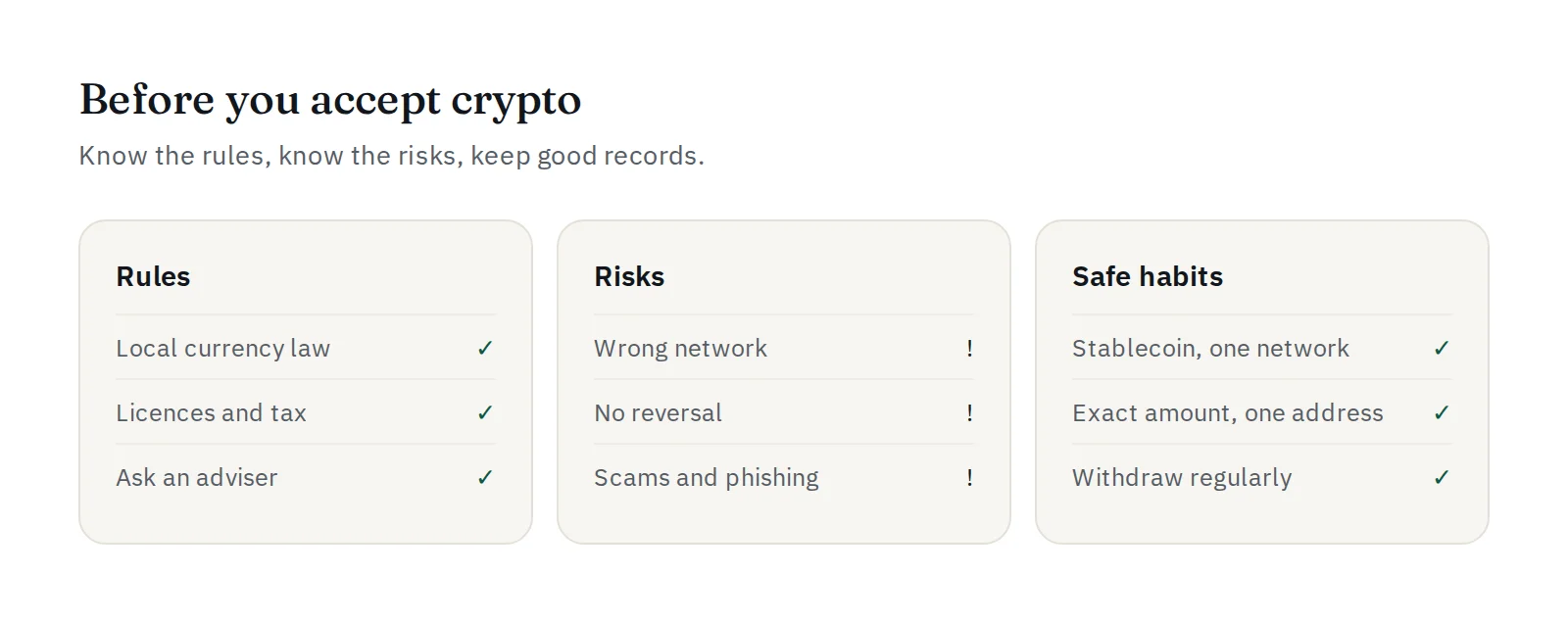
1. The rules
Every country treats crypto differently. Some allow it as a payment, some treat it only as an asset you can buy and sell, and some restrict it. Before you accept crypto, find out:
- Which currency is required for payments in your country. In Indonesia, for example, the law on currency requires the rupiah for payments made inside the country, and crypto is not a legal means of payment. Crypto assets are treated as digital financial assets that can be traded, supervised by OJK (since January 2025; before that by Bappebti).
- Who your customers are. Many businesses offer crypto mainly to customers abroad, who cannot easily pay with local methods, and keep local methods such as QRIS for local customers.
- Licences and tax. Your income from crypto payments is still income. Ask your accountant how to record and report it.
2. The risks
- Payments cannot be reversed. Crypto sent to the wrong address, or on the wrong network, is usually lost. This protects you from chargebacks, but it also means mistakes are expensive.
- Wrong network. USDT exists on several blockchains. A deposit on a different network than the one you asked for may never arrive.
- Price movement. Coins like Bitcoin can lose a large part of their value in days. Stablecoins such as USDT reduce this risk, but they are not risk-free.
- Scams and phishing. Fake support accounts and fake websites target crypto users, because stolen crypto is hard to recover. See fake "PAYWISE support" accounts and phishing.
3. Safe habits
- Stick to one stablecoin and one network. PAYWISE accepts USDT on BNB Smart Chain (BEP20) only, so customers always see one clear option. See what are USDT and BEP20.
- One address and an exact amount per order. PAYWISE gives every payment its own deposit address and the exact amount to send, so a payment is matched to the right order automatically.
- Ship only when the payment is confirmed. Wait for the Paid status or the
payment.paidwebhook, never for a screenshot of a wallet. - Withdraw regularly to your own wallet, and protect it well.
- Keep records of every payment and withdrawal for your bookkeeping and tax.
How PAYWISE helps
PAYWISE records USDT payments and fees in USDT, without converting them, and shows each payment's gross, fee and net amount. Paid USDT is available to withdraw as soon as it is paid. Read accepting USDT payments on BNB Smart Chain and QRIS or USDT: which should you offer.