

QRIS vs bank transfer vs virtual account: which suits your online shop?
A clear comparison of the three most common payment methods in Indonesia: speed, automatic confirmation, costs, limits and when to use each.
Published 04 October 2026 2 min read

Customers in Indonesia mostly pay online in three ways: QRIS, bank transfer and virtual account (VA). Each has its place. Here is how they compare.
QRIS
The customer scans a QR code with any banking or e-wallet app.
- Pros: works with almost every app, confirmed in seconds, and with dynamic QRIS each order is matched automatically. From 1 October 2026, payments up to Rp100,000 have 0% MDR for every merchant (details).
- Cons: each payment has a maximum amount, so very large invoices may not fit.
Bank transfer
The customer transfers to your bank account and sends a receipt.
- Pros: familiar to everyone, no setup.
- Cons: you must check every payment by hand, matching amounts is slow, and fake receipts are a real risk (how to stop them).
Virtual account
Each order or customer gets its own account number at a bank.
- Pros: confirmed automatically, suitable for large amounts and B2B invoices.
- Cons: usually tied to specific banks, so the customer may pay a transfer fee from another bank; providers usually charge a fee per transaction.
At a glance
| QRIS | Bank transfer | Virtual account | |
|---|---|---|---|
| Automatic confirmation | Yes | No | Yes |
| Any bank or e-wallet | Yes | Yes | Depends on the bank |
| Speed | Seconds | Manual check | Minutes |
| Large amounts | Limited per payment | Yes | Yes |
| Fake receipt risk | None | High | None |
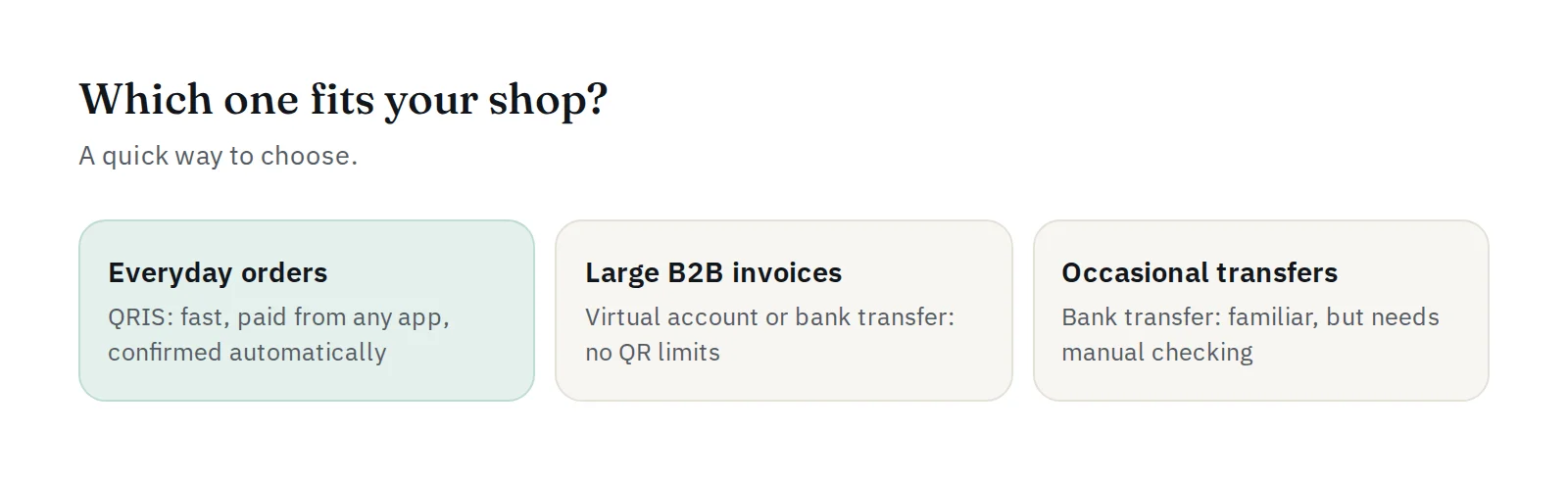
Which should you offer?
- Everyday online orders: start with QRIS. It is fast, confirmed automatically and almost every customer can pay.
- Large B2B invoices: add a virtual account or accept bank transfers for those few cases.
- Customers abroad paying in stablecoins: USDT (BEP20) (what is it?).
PAYWISE offers QRIS and USDT through one API, with automatic confirmation by webhook. Start with How to accept QRIS payments.