

What is the Digital Rupiah? A simple explanation for businesses
The Digital Rupiah is Bank Indonesia's own digital currency, still in testing. How it differs from e-wallet balances, QRIS and stablecoins, where Project Garuda stands in 2026, and what it means for merchants.
Published 20 October 2026 2 min read

You may have read about the Digital Rupiah (Rupiah Digital) in the news. It is a digital form of the rupiah issued by Bank Indonesia itself. It is not available to the public yet, but the project keeps moving. Here is a plain explanation.
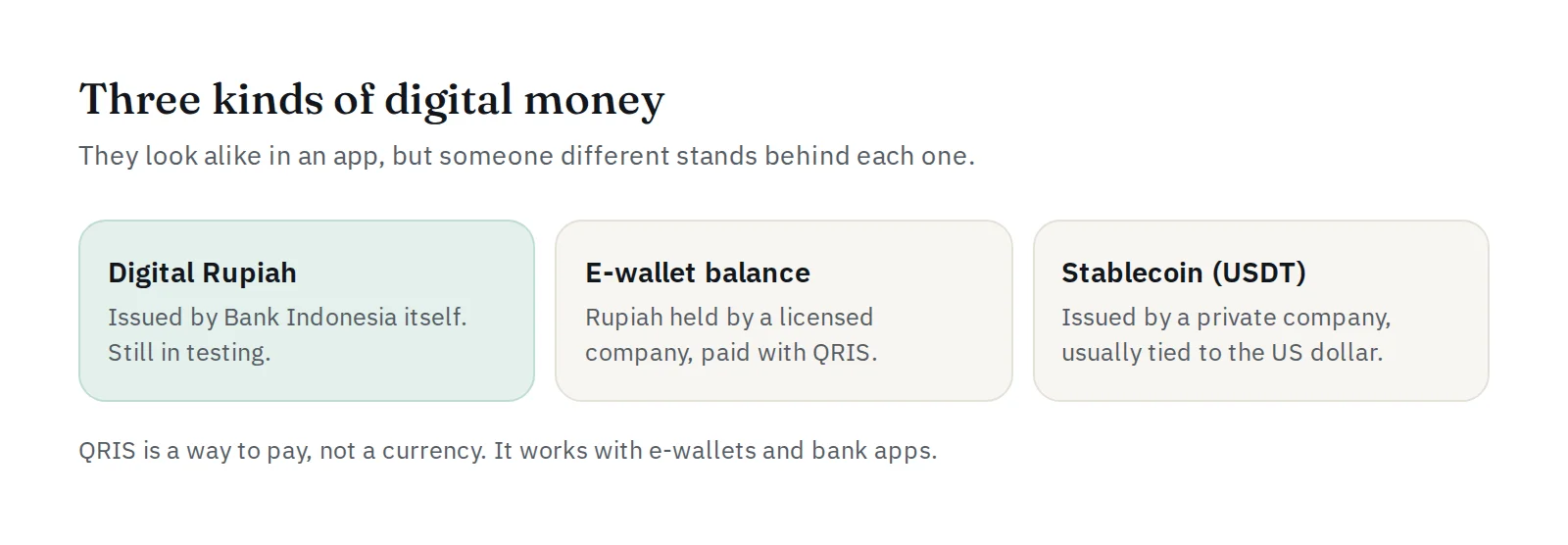
What the Digital Rupiah is
The Digital Rupiah is a central bank digital currency (CBDC). Like a banknote, it would be a direct claim on Bank Indonesia, not on a bank or an app company. Bank Indonesia designs it to complement cash, not to replace it.
How it differs from what you use today
- E-wallet balance: rupiah held for you by a licensed company. You pay with it through QRIS.
- Bank balance: rupiah held by your bank.
- Stablecoin such as USDT: a crypto coin issued by a private company, usually tied to the US dollar. It is not legal tender in Indonesia.
- QRIS: not money at all, but a way to pay. It connects bank and e-wallet apps to merchants.
Where the project stands
Bank Indonesia runs the Digital Rupiah under the name Project Garuda:
- A white paper (2022), followed by a consultative paper and a public consultation report.
- A proof of concept for the wholesale stage (a cash ledger between banks), completed in December 2024. BI said it would continue to the next, intermediate stage.
- In 2026: an opinion column by a Finance Ministry official on ANTARA (3 October 2026) reports that the BI Governor told the House's Commission XI on 28 September 2026 that BI has obtained a halal fatwa from the National Sharia Council for its digital currency and stablecoin framework, and that experimental cross-border testing of the Digital Rupiah has begun.
There is no public launch date yet.
What it means for merchants
For now, nothing changes. Customers keep paying with QRIS, bank transfer and cards, and you receive rupiah as usual. If the Digital Rupiah reaches the public one day, it would most likely work alongside existing methods, and payment providers would add it as another option.
Want to accept the digital payments people use today? Read what is QRIS and what is a payment gateway.
Sources: Bank Indonesia: Proof of Concept Proyek Garuda, ANTARA English, 3 Oct 2026.